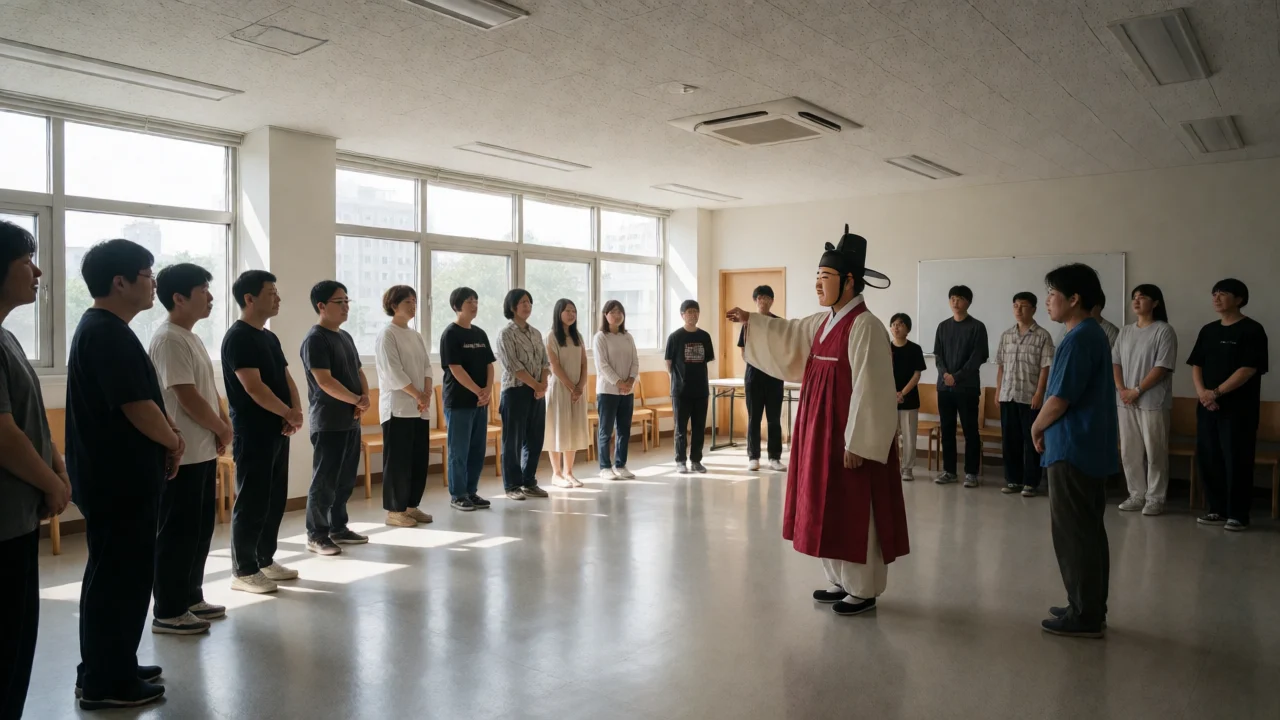
Instead of the rhythmic clash of gongs filling the village square, today’s gathering is missing its most important guest: the aristocratic Yangban. Behind the imposing, stern masks of traditional mask dance dramas lies a sharp, hilarious critique of elite incompetence and the witty defiance of commoner servants. Let’s step into the lively world of the Yangban yard.
Settle in and listen to the story at a gentle pace before you begin reading.
The Sannim is Nowhere to Be Found as the Rhythms Rise
Whenever ancient villagers wrapped up the farming year with a grand celebration, they would gather in the heart of the yard, slip on masks, and lose themselves in play. Whether it was traditional mask dances, Gyeonggi’s Sandae-nori, or the seaside yaryu and ogwangdae of Gyeongsang-do, one fixture never failed to appear: the Yangban—haughtily lifting their chins and swaggering about, completely devoid of actual substance.
Yet today, the village square hosting the festival was facing an unusual dilemma. The barrel drums were thumping and the gongs were ringing out brightly, but Kim Chambong, the elder tasked with playing the central Sannim role, was nowhere to be seen.
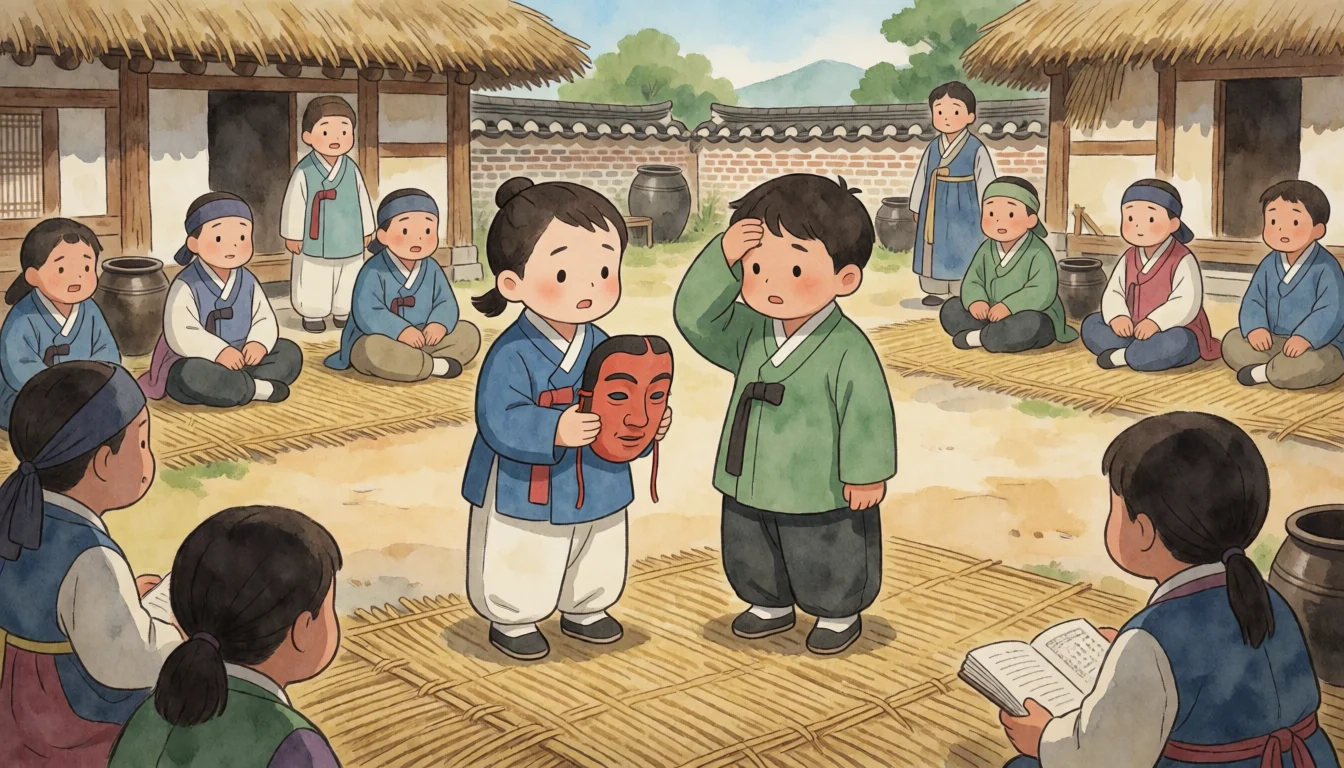
Chunsam, clutching the Malttugi mask in his hand, paced anxiously at the edge of the yard, tapping his foot.
“Dolsoe, did you make sure to send proper word to Elder Kim Chambong’s estate? The audience has already surrounded the straw mats, and we can’t even start the performance!”
Dolsoe wiped the sweat beading on his forehead with his sleeve and shook his head.
“I went ages ago. Who knows, maybe some sudden lawsuit popped up at his house; he was scrambling through his books right in the middle of dressing in his formal robes. He said he’d be right here, but the sun has already climbed well past the middle of the sky.”
Hearing the excited chatter of spectators leaking in from outside, Chunsam licked his dry lips.
Shall We Unpack These Nobles’ Dubious Pedigrees?
“If we just keep waiting around for the elder, the crowd’s all going to scatter. You can’t just lay out straw mats and play the gutgeori rhythm all day long.”
Chunsam firmly pressed the menacing, reddish Malttugi mask to his face and plopped down right in the middle of the yard. Dolsoe’s eyes widened as he asked,
“Are you going to step out into the yard all by yourself with no Sannim in sight?”
“No, let’s just practice our satirical banter to our heart’s content first. Remember the lines the Tongyeong Ogwangdae performers used to do? The ones where they tore down the pretenses of high-born phonies right from behind their masks?”
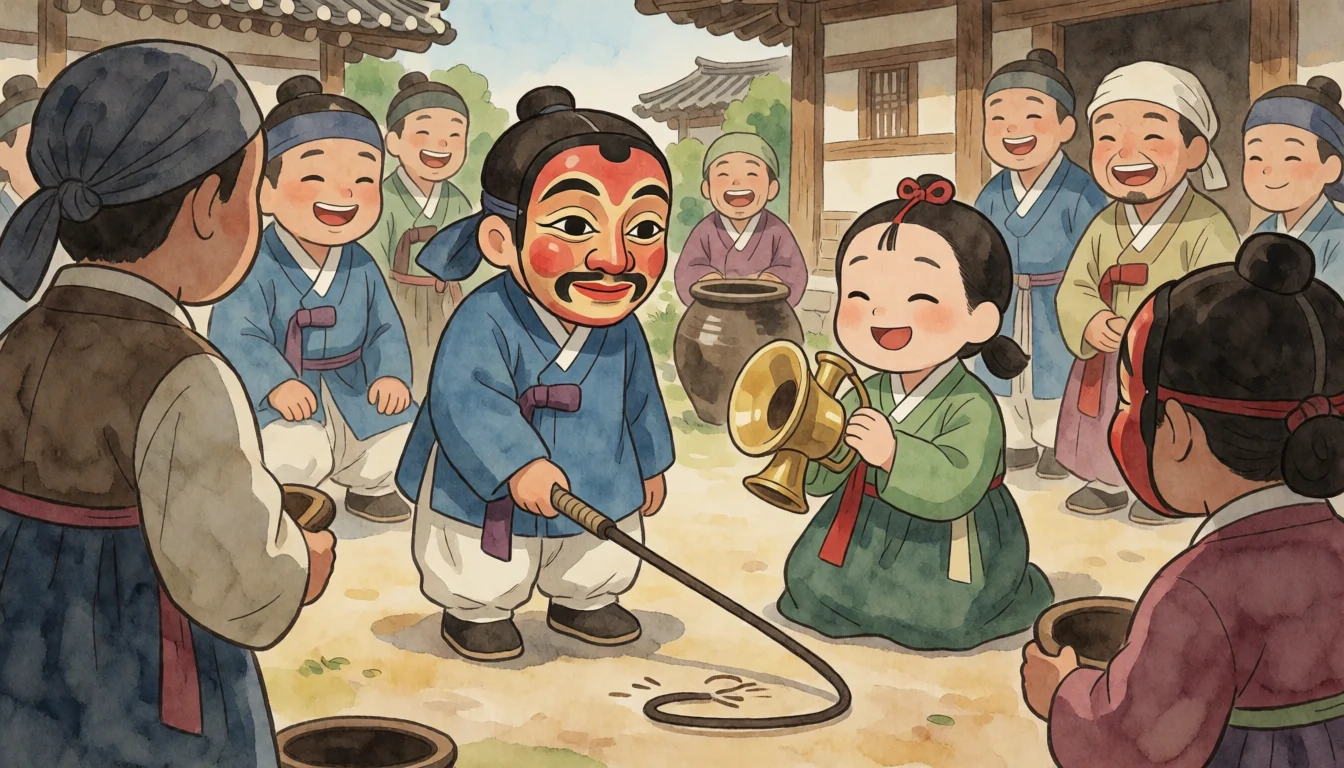
Clearing his throat with a mischievous grin, Chunsam tapped his horsewhip sharply against the ground.
“Step aside, the Yangban are coming! You think because they’re called Yangban they’re high-ranking ministers from the royal court? The founding ancestor of the primary Yangban was born of eight different courtesans, and the secondary Yangban trailing behind him is nothing more than the lowly child of a concubine!”
Caught up in the infectious excitement, Dolsoe chuckled and kept the rhythm steady with his jing gong mallet. The traditional musicians watching from the side pricked up their ears at Chunsam’s sharp wit.
“And what about the Red-and-White Yangban? With a red cheek stuck next to a white cheek, he’s got two fathers—Mr. Hong and Mr. Baek! As for the Black-Ink Mask Yangban, his mother must have brought bad luck upon herself because he looks just like a lump of charcoal!”
“Ho ho, you can’t leave out the Pox-Scarred Yangban and the Crooked Yangban!”
Dolsoe chimed in playfully, prompting Chunsam to push the joke even further.
“The Pox-Scarred Yangban wears deep scars carved by the smallpox spirit, and the Crooked Yangban is twisted all over so he can’t even stand up straight! People whose very origins are shameful, yet they strut around in horsehair hats and dopo robes trying to squeeze the common folk—what a pathetic spectacle!”
Spurred on by the relentless banter, the villagers huddled at the back of the yard began to double over with laughter.
The Flustered Sannim Arrives with a Thunderous Scolding
“And they say the Monk-Faced Yangban was born because his mother, a Buddhist nun, took up with another man! Where else could you find such absolute scoundrels?”
It was right as Chunsam swung his horsewhip and belted out this final line—
“W-Wait right there! You rascal Malttugi, how dare you utter such monstrous nonsense in front of—!”
Kicking up a flurry of dust, someone came barreling breathlessly into the edge of the yard. It was none other than Elder Kim Chambong, his horsehair hat knocked crooked over one ear, his robe hem soaked in muddy water, gasping for air.
The elder let out a booming, theatrical cough to assert his dignity.
“Ahem! Hmph! To show such lack of decorum… daring to insult the genealogy of a noble aristocratic lineage… hmph, hmph, I will not forgive this!”
Yet, completely out of breath, his voice cracked with every final syllable, and having run in such a rush, one of his traditional socks had slipped off, leaving his bare toes poking out of his straw shoes.
Seeing this miserable sight, the onlookers began murmuring amongst themselves.
“Look at that—I thought the Crooked Yangban Chunsam was just talking about had come to life!”
“Oh my, he looks like he lost all strength in his legs just trying to preserve his noble dignity!”
The harder the elder tried to glare and look authoritative, the more he looked like the helpless, incompetent Sannim from the mask dance plays. A wave of uncontrollable laughter finally erupted across the entire yard.
A Stage Where Masks Make Everyone One
Elder Kim Chambong’s face turned as red as a ripe persimmon. He raised a finger to scold them, but hesitated. Instead of shrinking away in fear at his terrifying reprimand, the crowd was bubbling over with clear, bright laughter, leaving him completely at a loss as he nervously tried to straighten his crooked hat.
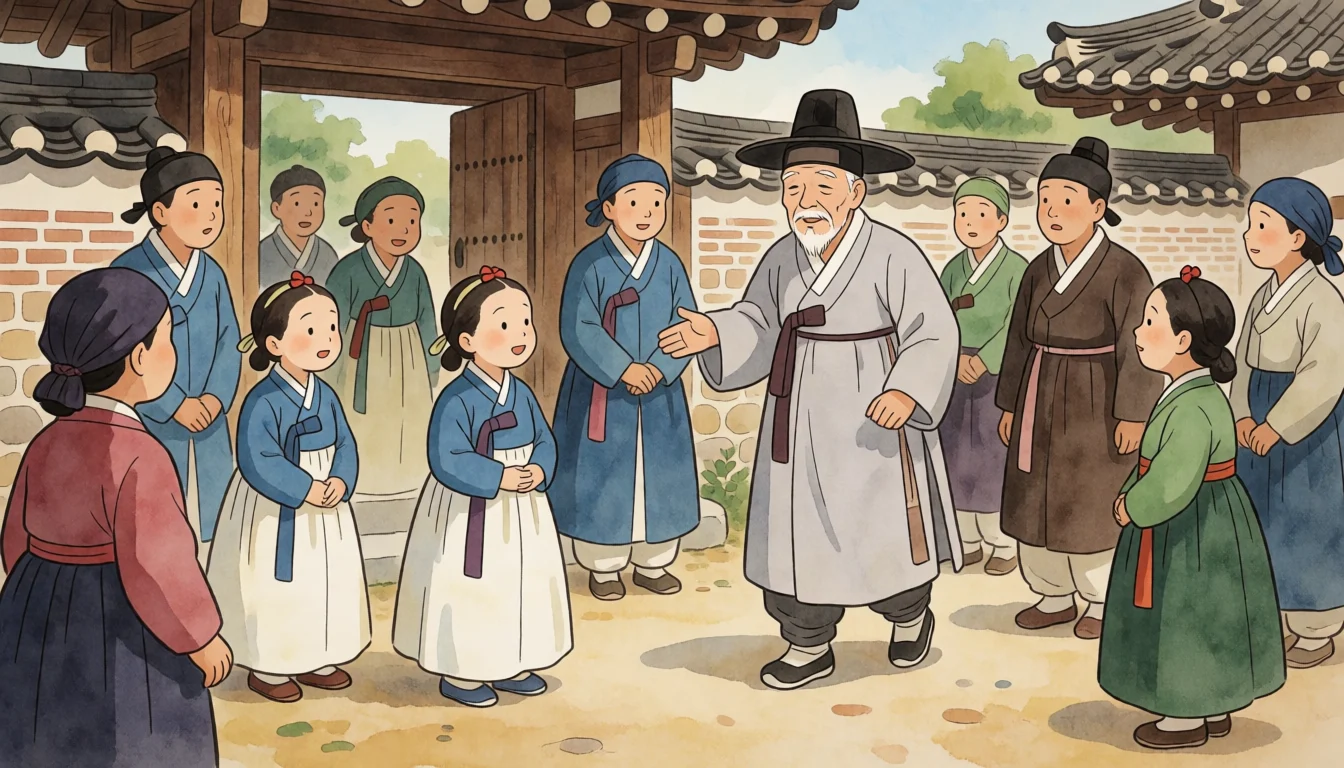
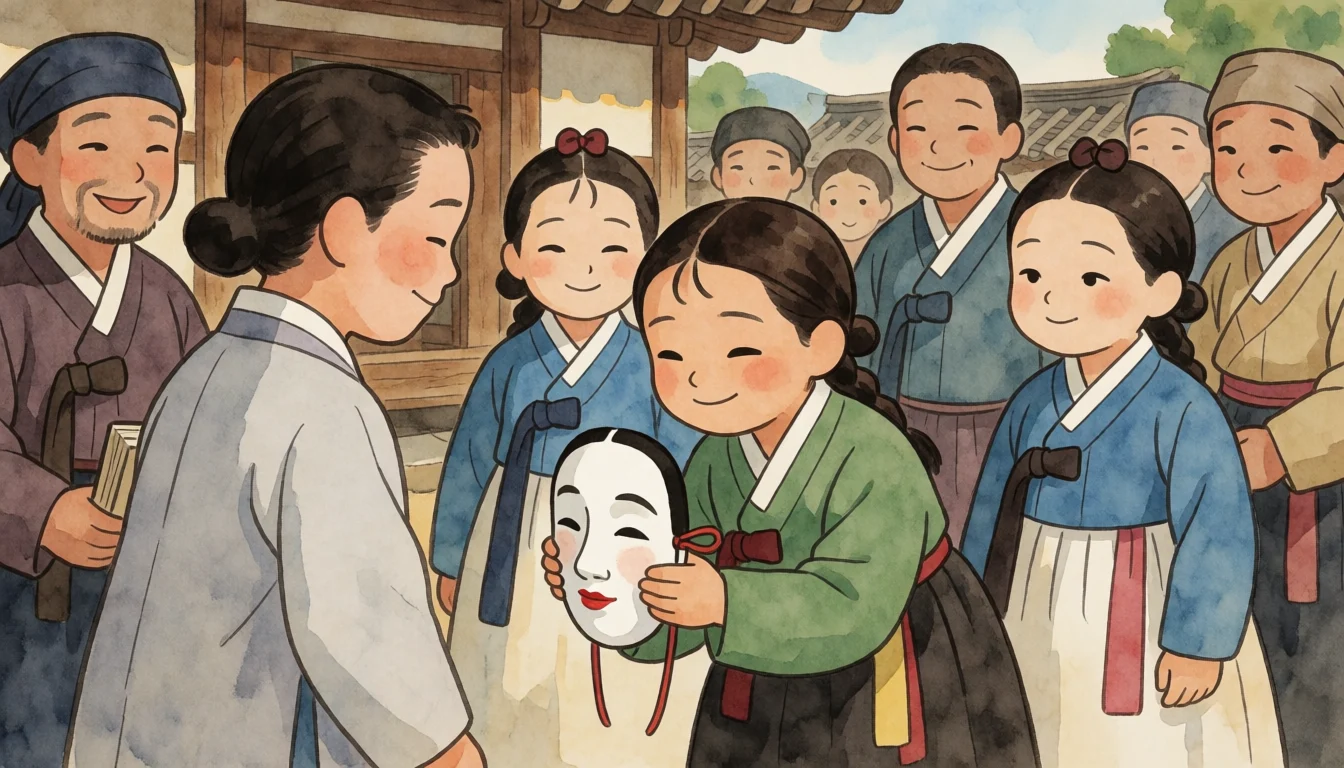
Sensing his moment, Dolsoe quickly stepped forward, bowed deeply, and respectfully held out the white Sannim mask he had been carrying.
“Elder, thank you for your arduous journey here. Since we didn’t have a great elder present to properly show off aristocratic dignity, we were just spouting nonsense amongst ourselves. Please, put on this mask right away and teach this insolent Malttugi a sharp lesson!”
Catching Dolsoe’s sly wink instead of flying into a rage, Chunsam lowered his horsewhip and returned a deep bow.
“Indeed so, Sannim! This Malttugi was blind and failed to recognize a true great noble—please, let loose your thunderous scolding once more!”
Kim Chambong stared blankly back and forth between the two, before finally letting out a hollow, defeated chuckle.
“Well, well, you mischievous rascals. You really planned this out just to mock me, didn’t you?”
Brushing off his dirt-stained sleeves without hesitation, the elder snatched the white Sannim mask and shoved it firmly onto his face. His eyes twinkled with playful mischief through the eye-holes.
“Quiet—! Malttugi, if you’ve summoned a Yangban, shouldn’t you be bowing to the ground first? What’s with all the idle chatter!”
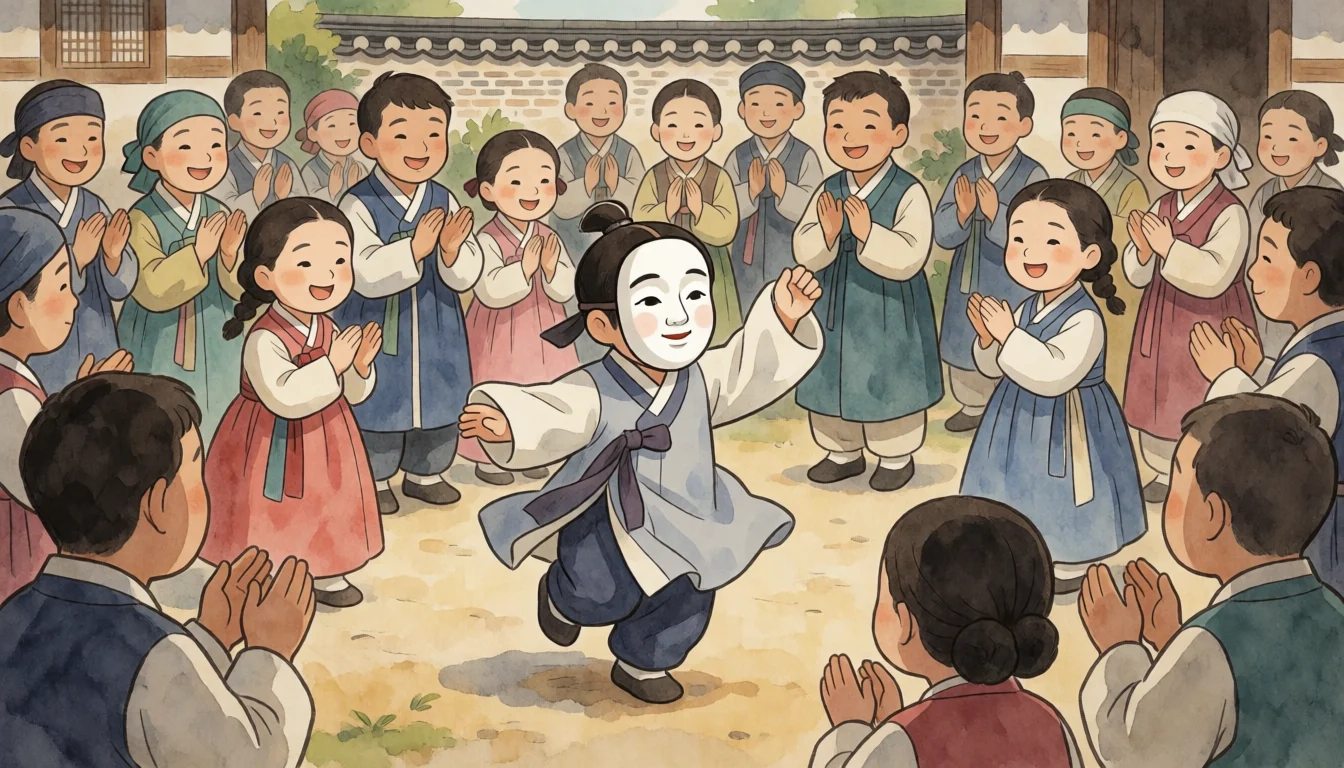
As Kim Chambong, wearing the mask, began to flap his robe and awkwardly dance a clumsy shoulder-shake, the gongs and hourglass drums crashed in lively response.
The biting mockery of the servant and the shameless bravado of the aristocrat tumbled together within the rhythmic beats. Washing away pent-up grievances in a wave of refreshing laughter, the mask dance yard blossomed into a jubilant, liberating celebration where everyone stood shoulder to shoulder as equals.
Satire and Humor of the Yangban in Mask Dances
In the Yangban scenes of traditional Korean mask dance dramas across various regions (such as Sandae-nori, Haeseo mask dances, and Yaryu/Ogwangdae), various aristocratic characters appear who boast of their authority and dignity, yet remain feeble, incompetent, and subjected to mockery and belittlement by servants like Malttugi. This served as a core element of traditional folk theater, fiercely criticizing and relieving the hypocrisy of the Joseon-era nobility from the perspective of the common people.
Types of Yangban Characters in Regional Mask Dances
Gyeonggi Sandae-nori: Yangju Byeolsandae-nori and Songpa Sandae-nori feature characters like the Sannim, Seobangnim (young gentleman), and Doryeong (young master). The Sannim flaunts his status and authority but is mocked by Malttugi or Soettugi, being portrayed as a helpless, incompetent figure. Notably, the Sannim in Taegwewon Sandae-nori is depicted as someone who purchased his aristocratic title through official corruption.
Hwanghae-do Haeseo Mask Dances: Bongsan Mask Dance features the Saengwon (eldest Yangban), Seobang (second Yangban), and Doryeong (third Yangban) who are mocked by Malttugi. Gangnyeong Mask Dance features the eldest Yangban, Jinhan Yangban, Jaemul-daegam, and Doryeong, with the eldest Yangban wearing a dog-skin hat and exchanging witty banter. Enyul Mask Dance features the first, second, and third Yangbans, who face humiliation and disdain from Malttugi.
Gyeongsangnam-do Yaryu and Ogwangdae: Regional performances such as Suyoung Yaryu, Dongnae Yaryu, Tongyeong Ogwangdae, Goseong Ogwangdae, and Gasan Ogwangdae feature diverse Yangban characters—including Su-yangban, Won-yangban, Cha-yangban, Mo-yangban, Hongbaek-yangban, Bibi-yangban, and Jongga-doryeong—serving as targets of satire and humor.
Exposing the Pedigrees and Traditional Lines of the Yangban
In performances like the Tongyeong Ogwangdae, dialogues are passed down where Malttugi thoroughly exposes the lineage and genealogy of the Yangban. He mocks the primary Yangban whose ancestor had eight courtesans, the secondary Yangban born as a concubine’s son, the Red-and-White Yangban with two fathers (Mr. Hong and Mr. Baek), and the Black-Ink Mask Yangban whose mother brought bad luck. Additional figures are mercilessly satirized, including the Pox-Scarred Yangban marked by smallpox, the Crooked Yangban whose body is twisted by stroke symptoms, and the Monk-Faced Yangban born from a Buddhist nun’s affair, all serving to sharply critique the hollow facade of the aristocracy.
Transmission and Significance of Traditional Mask Dances
Korea’s traditional mask dances and the satirical banter between nobles and servants within them continue to preserve their historical and cultural value today through regional transmission styles and folk drama research.
The Boundary Between Fiction and Historical Fact in the Story
The anecdote in the main story where Kim Chambong arrives late, leaving Dolsoe and Chunsam anxious behind the yard, and the comedic commotion caused by Kim Chambong rushing in with disheveled attire, are fictional elements created to help readers understand the context. On the other hand, the setup in regional Korean mask dances (Sandae-nori, Haeseo mask dances, Yaryu/Ogwangdae) where Yangban characters display incompetence and arrogance only to be mocked by servants like Malttugi, as well as the specific lineages of the Won-yangban, Cha-yangban, and Hongbaek-yangban satirized by Malttugi in the Tongyeong Ogwangdae, are historical and folkloric facts rooted in actual historical texts and folklore materials.
🎨 Color This Story Yourself