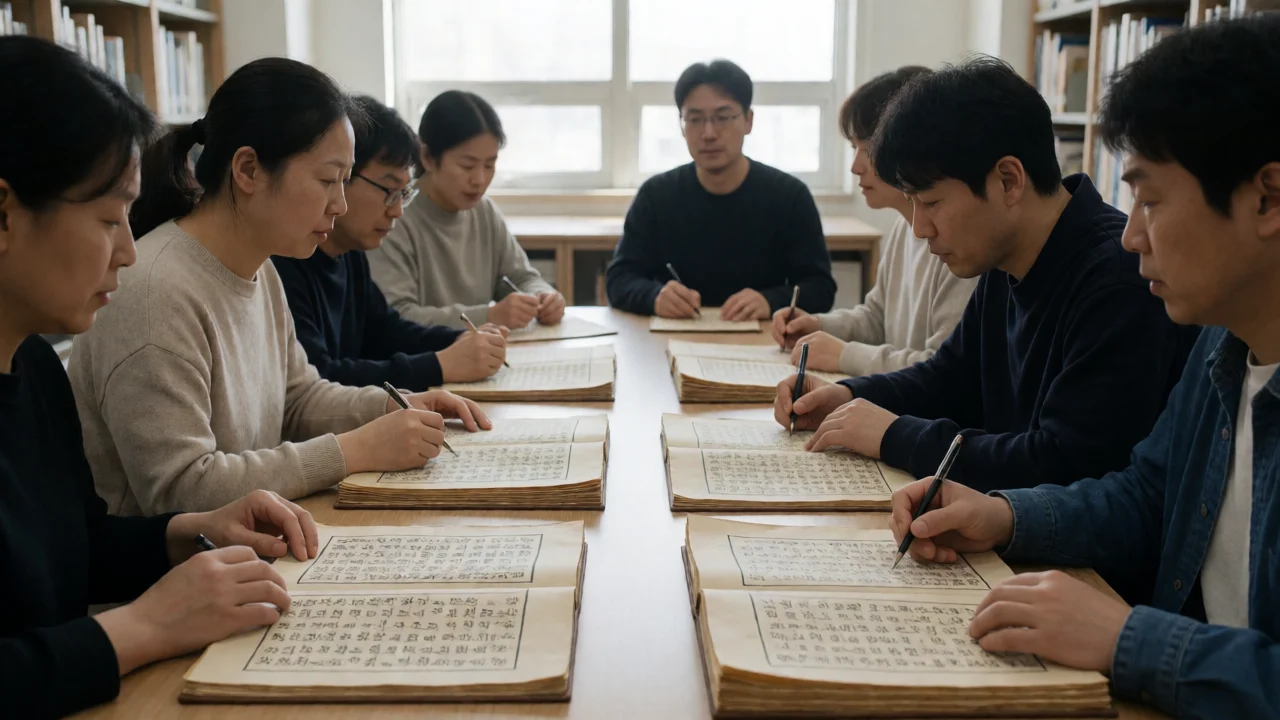
Discover the tragic and satirical tale of a male pheasant and a female pheasant who argued over a single red bean in a snowy field, alongside the history and transmission of *Jang-gwi-taryeong*, one of the twelve traditional *pansori* masterpieces.
Settle in and listen to the story at a gentle pace before you begin reading.
Bitter Winter and Empty Pantries in Yangji Village
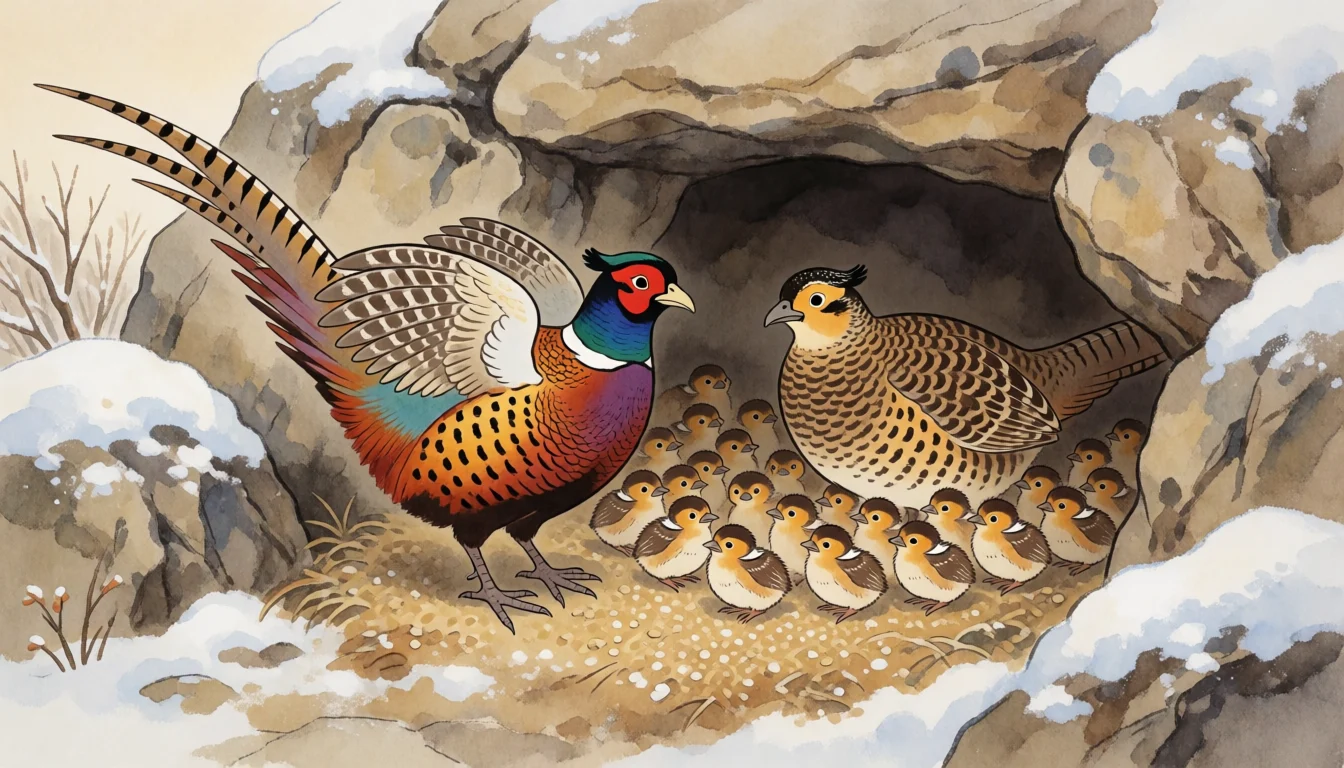
It was a day when a fierce winter wind swept across the mountain ridge. Inside the nest tucked away in the rocky crevices of Yangji Village, a pair of pheasants—a male and a female—sat surrounded by little more than sorrowful sighs. Twenty-one little chicks—twelve sons and nine daughters—tucked their feathers tightly against themselves and chirped hungrily.
“Oh dear, what are we going to do?” the male pheasant sighed, his tail feathers trembling. “Even the grain we borrowed from the field mouse ran out down to the last kernel yesterday.”
Tucking the little ones close to her wings, the female pheasant swallowed hard. “Night is falling, and the blizzard shows no sign of stopping. If we just stay huddled here like this, the children won’t survive the cold and starvation.”
Hearing their rapid, shallow breathing, the male pheasant stood up and fluttered his wings, deciding he could wait no longer. Not a single blade of grass remained to peck at in the mountain ravine. Before nightfall completely swallowed the valley, the pair resolved to fly down to the broad plains below in search of food.
A Single Red Bean on the Snowfield
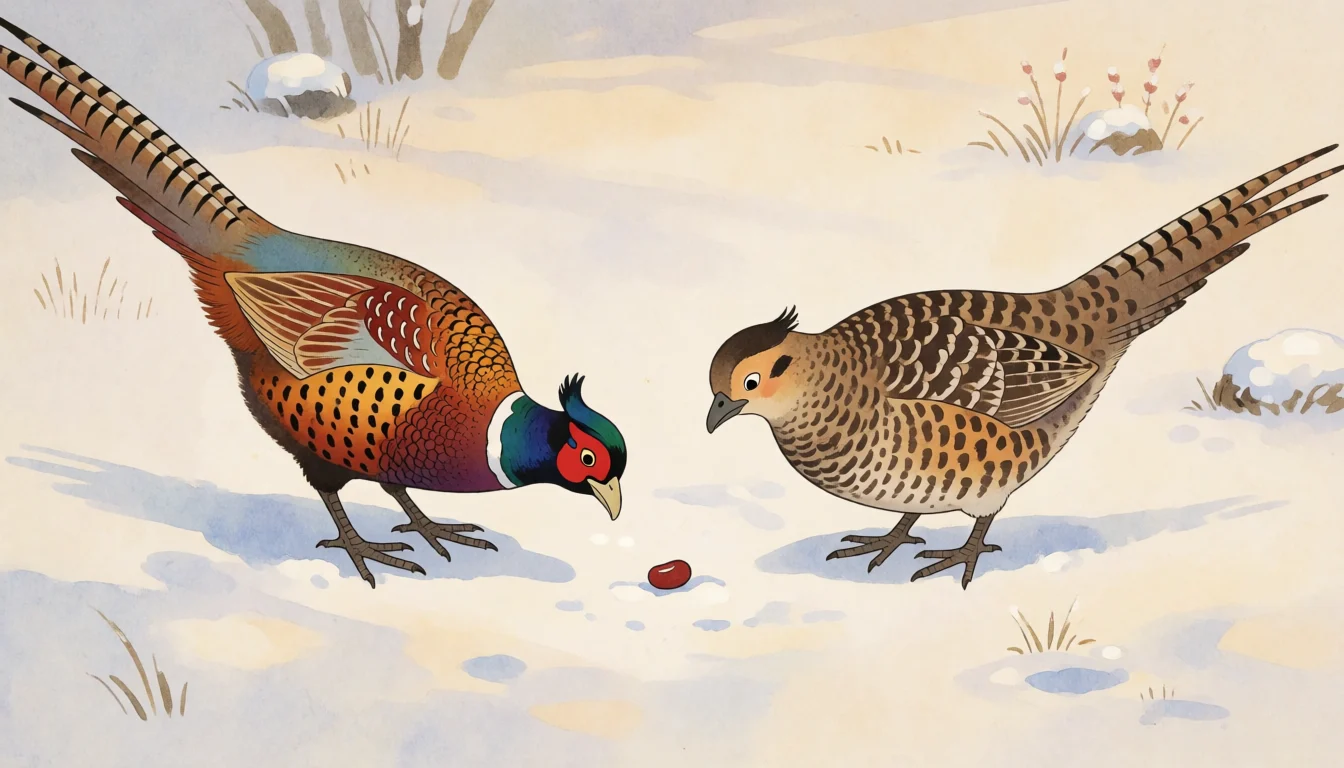
The plains they flew into, braving the harsh wind, were a completely white world of snow. As the male pheasant carefully picked his way across the untouched snowfield, his eyes suddenly widened. Right in the middle of a snowy hollow lay a single, plump, glistening red bean.
“Look at that, my dear!” he cried, unable to contain his joy as he stretched his neck and stepped eagerly forward. “Heaven must have sent us this blessing so our family wouldn’t starve!”
However, the female pheasant, following closely behind, suddenly froze. Examining the snow around the bean closely, she quickly grabbed his wingtip with her beak.
“Stop for a moment, my dear! Why would a single, perfect bean be sitting all by itself in the middle of this vast, rough snowfield? Look closely around it. Aren’t there scattered bits of rice straw and clear signs of human footprints?”
“What are you talking about? They’re just blade marks buried in the snow,” the male pheasant scoffed, stamping his feet. “Think of our chicks with their bellies stuck to their backbones—we need to grab it right now!”
The sun was dipping toward the western mountains, and his mind was consumed by impatience for food.
A Foreboding Dream and Stubborn Pride
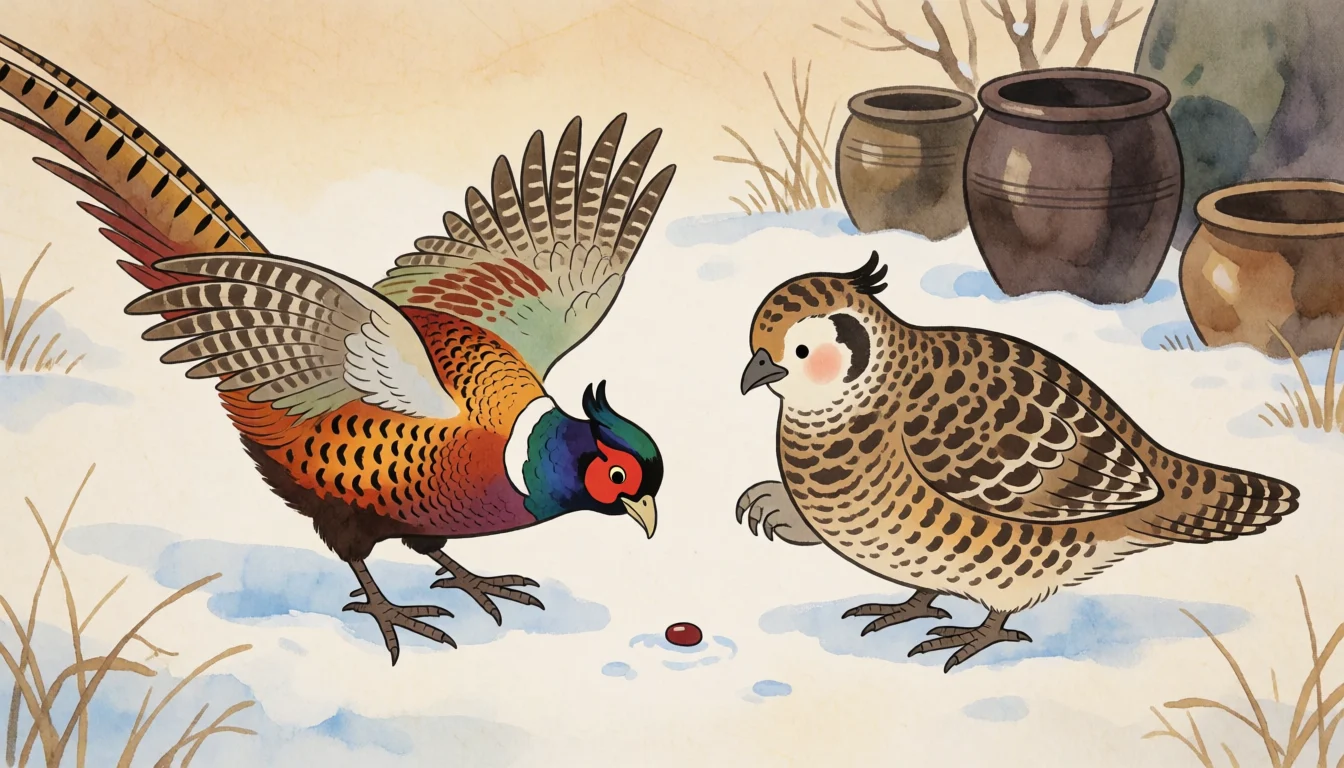
Refusing to back down, the female pheasant blocked his path with her entire body, fear and desperation shining in her eyes.
“My dear, please don’t brush my words aside. Last night, I had a deeply ominous dream. Out of nowhere, a black cloud swooped down and grabbed you by the hair, and a thunderbolt struck from the blue sky, leaving me gasping for air. That bean is surely a trap set by a hunter!”
The male pheasant, however, let out a hollow, dismissive laugh and pushed past her.
“Dreams are nothing more than vain delusions! Even if a scholar dreams of passing the state examination, he’ll still fail if he doesn’t study. Does food ever walk into your mouth just because you had a good dream? There’s a bean right in front of us—what is this nonsense about a dream? If you don’t want to eat it, I’ll eat it first and bring some back to the chicks, so step aside!”
“No, you mustn’t, my dear! Please, just step back and look around one more time!”
She pleaded and wept, but blinded by hunger and stubborn pride, the male pheasant refused to listen. Spreading his wings wide, he plunged his beak straight toward the red bean.
The Snap of the Trap and a Choice at the Edge of a Cliff
“Snap!”
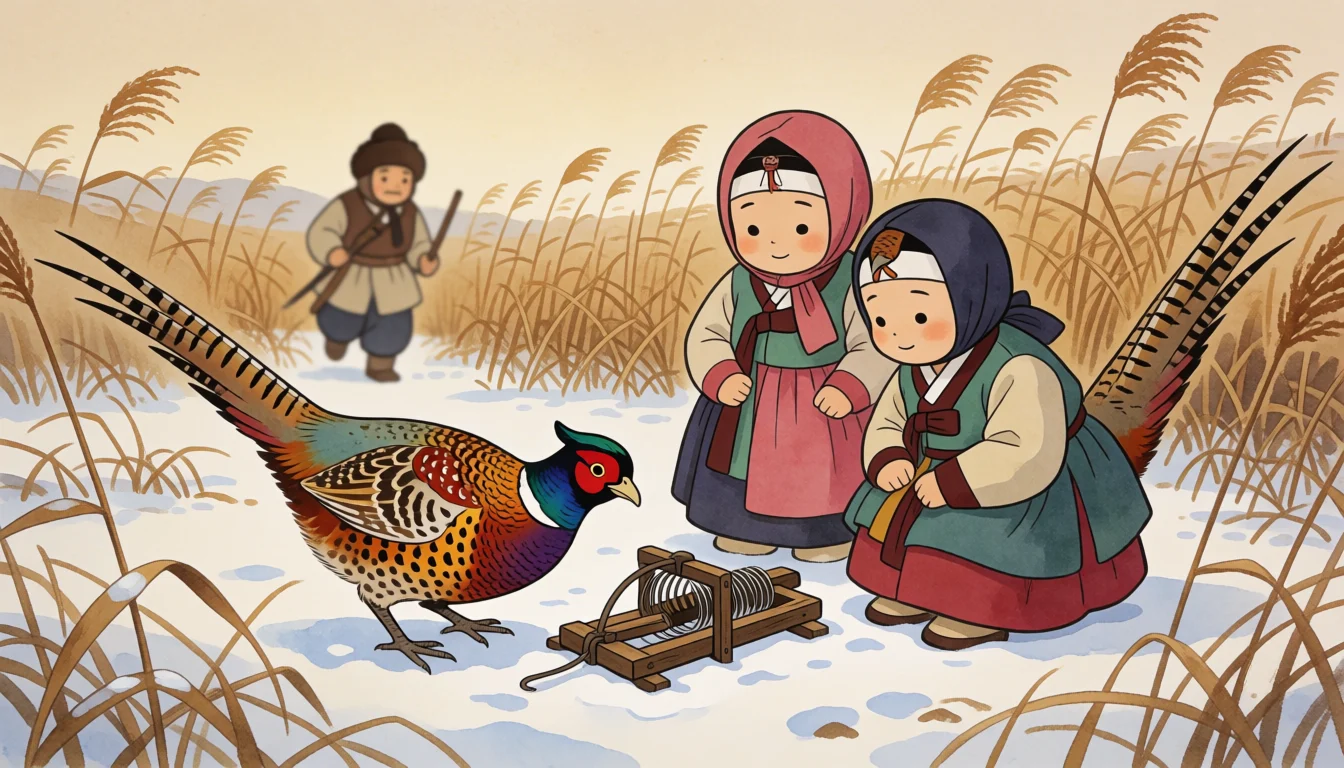
At that instant, a sharp, heavy metallic sound—as if the snowfield itself were splitting—shook the plains. A hunter’s spring-trap, cleverly hidden beneath the bean, sprung upward and clamped tightly around the male pheasant’s neck. Crimson feathers scattered into the air as he thrashed in the snow, but the tighter he struggled, the more fiercely the noose tightened.
“Oh dear! What is happening?!”
Crying out in terror, the female pheasant rushed forward, pecking and pulling at the wooden frame of the trap with her beak. But her delicate beak could not release the thick wooden contraption. Just then, the sound of heavy footsteps echoed from beyond the dry reed beds. Tak Cheom-ji, pulling his fur cap down low, was striding over to check the trap.
Gasping for breath, tears streaming from his eyes, the male pheasant spoke:
“Kka-tu-ri… I didn’t listen to you, and now I’ve been caught in a trap after all. I used to blame my fate for marrying a wife whose previous husbands had passed away, but in the end, my own blindness and stubbornness brought this disaster upon us… The hunter is coming, so hurry and take the children away. If you try to save me, you’ll die too…”
The approaching hunter’s shadow stretched long across the snow. Her heart was breaking, but if she hesitated by her mate’s side now, even the chicks hiding in the bushes would lose their lives to the hunter. Swallowing her tears of blood, she had to make a choice.
Returning to Yangji Village Through Tears
While Tak Cheom-ji gathered the trapped pheasant and slung it over his shoulder, the female pheasant slipped silently into the reed thicket, gathering her chicks beneath her wings. As the hunter’s footsteps faded into the distance, she didn’t even have a moment to wipe her tears before leading the trembling children into the darkening sky.
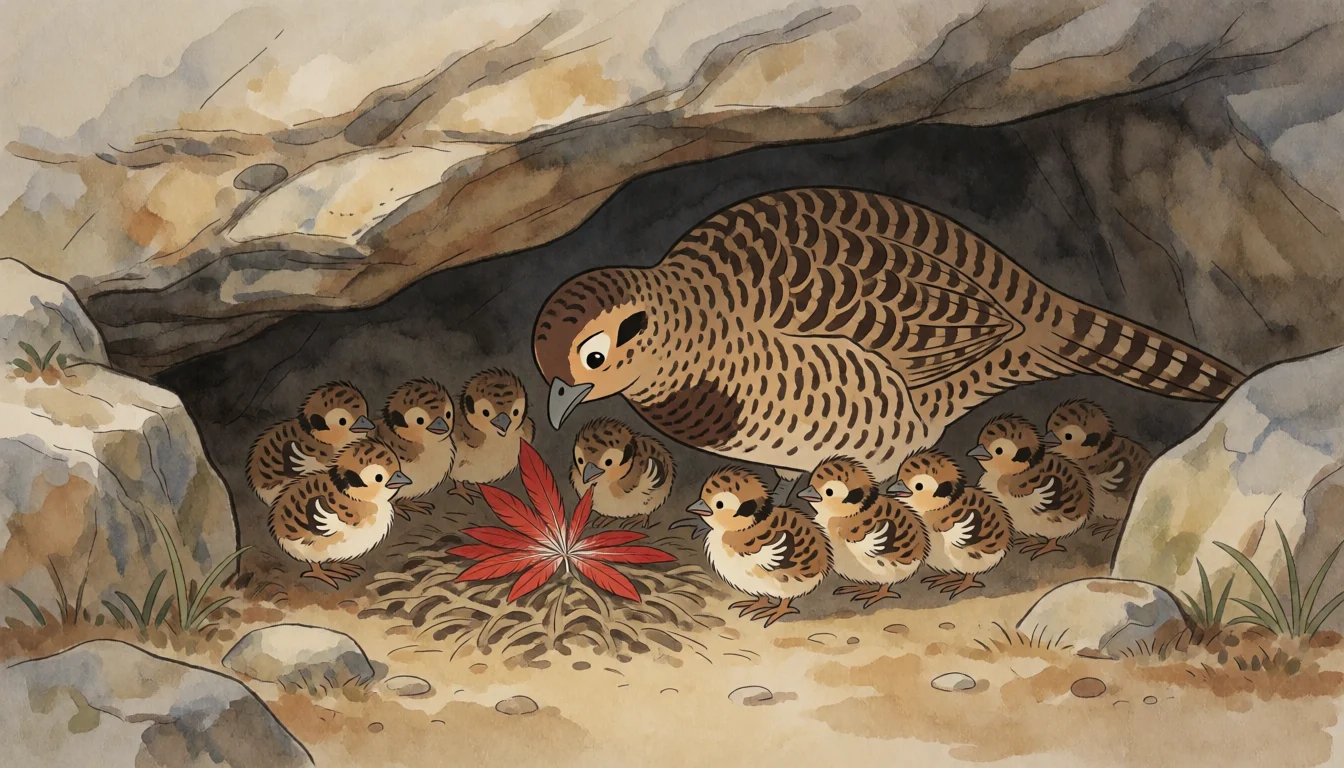
Returning to their rocky nest in Yangji Village, the mother and chicks wept bitterly at the empty space left behind. Carefully collecting a few of the red feathers the male pheasant had left in the snow, she buried them beneath the shade of a rock to hold a simple memorial service for his spirit. The young chicks huddled close around their mother, pressing their little beaks together to share their grief.
“Your father’s stubbornness brought a tragic end, but we must live,” she said in a low, firm voice. “We must endure this cold winter together.”
At her words, the chicks burrowed deeper into her embrace, sharing each other’s warmth. Though they had lost their father in vain, the surviving family members began to brave the harsh blizzard and bitter winter together, comforting one another under their wings.
Jang-ggi-taryeong is one of the twelve traditional *pansori* masterpieces that satirizes human society by personifying birds like pheasants. Performed during the late Joseon Dynasty, its presence is recorded in Song Man-jae’s Gwan-u-hui and Lee Yu-won’s Gwanguk-si, indicating it was already performed by the mid-18th century. Famous performers included Yeom Gye-dal and Han Song-hak, but as the *pansori* repertoire was condensed from twelve blocks down to six and then five during the mid-to-late 19th century, the performance tradition was lost. However, the *pansori* lyrics have survived and branched out into various classical novels, folk songs, and narrative verses such as Jang-ggi-jeon, Kkwong-jeon, and Hwa-chung-jeon.
The work deeply reflects the changing historical realities and ethical views of the mid-to-late Joseon Dynasty. During this period, traditional views on widows maintaining lifelong chastity began to waver, with more women remarrying after losing their husbands—a shift reflected in the ending’s themes of chastity versus remarriage. Furthermore, the extreme poverty of the pheasant family and threats from hunters, hounds, beaters, and goshawks reflect the harsh realities faced by commoner farmers under the exploitation and oppression of ruling elites and local officials.
Although the traditional *pansori* singing performance of *Jang-ggi-taryeong* was discontinued, its lyrics have been preserved in various literary forms such as classical novels and folk songs, serving as an important asset for the study of traditional Korean narrative culture and *pansori*-derived literature.
The narrative covering the pheasant couple’s winter survival, their conflict over the red bean, the trap accident, Tak Cheom-ji’s retrieval, and the female pheasant’s return to Yangji Village is reconstructed based on the transmitted plot of the *pansori* and classical novel *Jang-ggi-taryeong*. However, specific dialogue, psychological nuance, and minor actions in the snowfield are creative literary additions. The work’s reflection of changing chastity ethics and peasant exploitation is rooted in historical evaluation, and the diverse endings found across various source texts are respected as part of the transmission tradition.
🎨 Color It Yourself