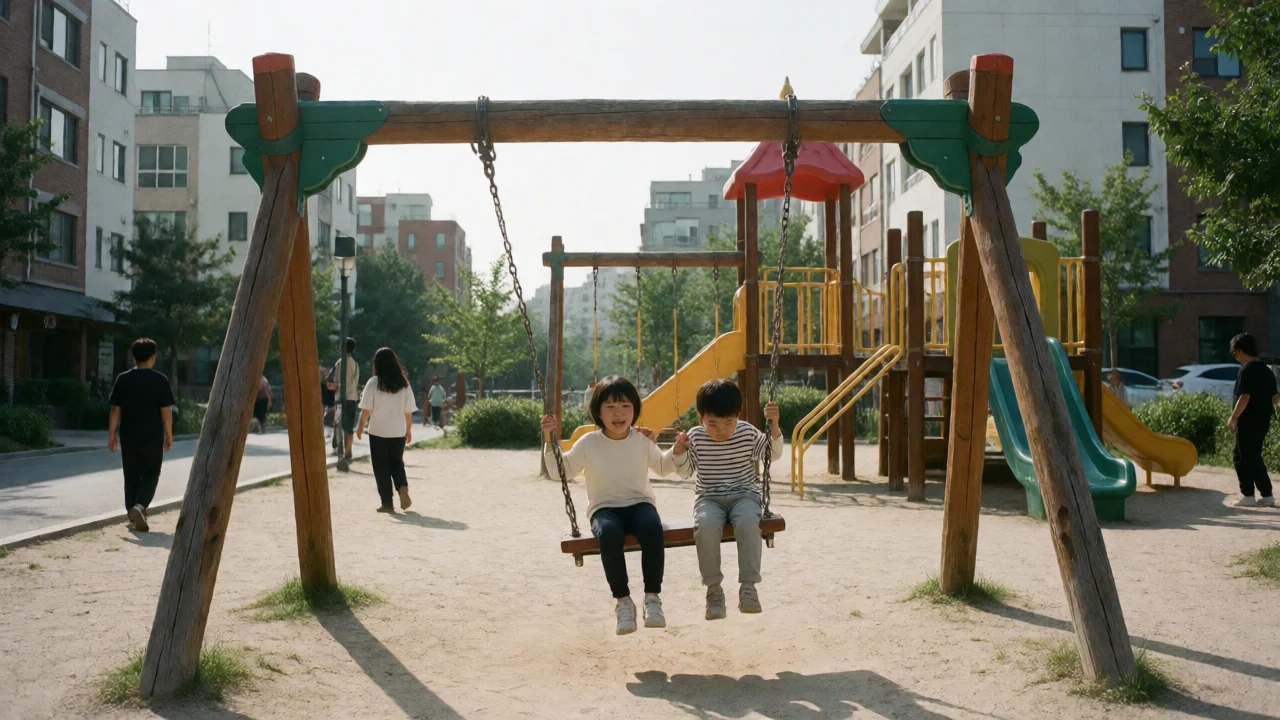
Ahead of Dano on the fifth day of the fifth lunar month, join young Dungi and Pati as they rig up a swing beneath a zelkova tree, and explore the history and culture of geunetwigi (swinging), which flourished among commoners in Joseon-era Korea.
Settle in and listen to the story at a gentle pace before you begin reading.
May Dano and the Village-Entrance Swing Site
As Suritnal—the Dano festival on the fifth day of the fifth lunar month—approached, the old village entrance used to bustle from early morning. In the Goryeo dynasty, it was called ‘chuchun’ or ‘chuchunhui’, enjoyed lavishly by the royal court and yangban nobility. But in Joseon’s ordinary folk villages, affectionately called ‘geunde’, ‘gunde’, or ‘geundui’, it turned into a lively game enjoyed by everyone, young and old alike.
Yet on that particular morning, as youngsters and villagers began gathering under the village’s thickest zelkova tree, a young man named Dungi was stamping his feet and peering anxiously down the alleyway.
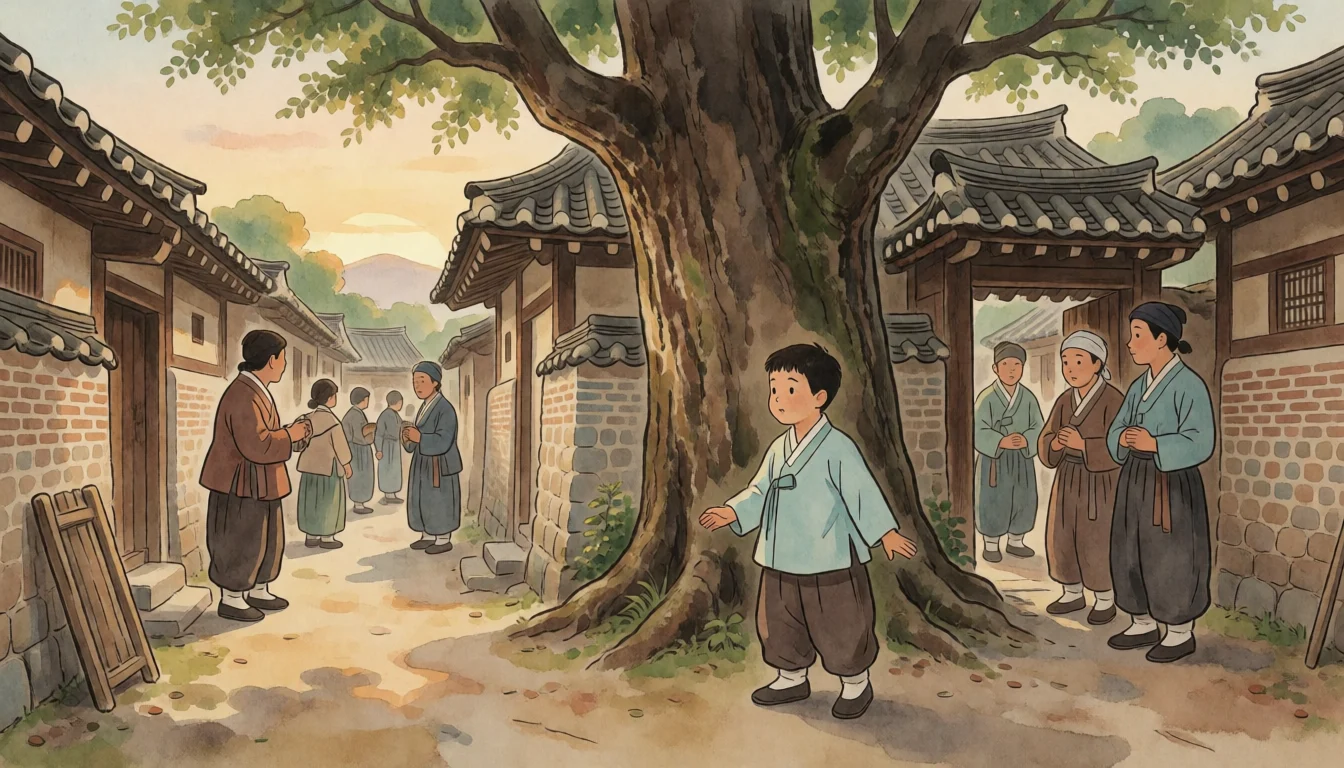
The Missing Friend and the Thick Hemp Rope Tackled Alone
“That rascal Pati, why isn’t he showing his face when the sun is already high in the sky?”
Unable to wait any longer, Dungi grabbed a bundle of thick hemp rope resting by the yard. He needed to finish rigging and testing the swing today to enter tomorrow’s Dano competition, but Pati, who had promised to help shape the footboard together, was nowhere to be seen.
“Bah, if I wait any longer, the day will be over. I’ll hang it myself first.”
Dungi hoisted the heavy hemp-woven rope over his shoulder and strode up a ladder toward a thick branch of the zelkova tree. However, pulling up a rope as thick as a grown man’s forearm and balancing it alone was no easy feat. Every time he hauled the rope up, the knot would slip and tumble down to the dirt floor.
The Upside-Down Footboard and Breaking a Sweat
After struggling for a long while, Dungi barely managed to loop two strands of rope around the tree branch, picked up a wooden board lying on the ground, and hastily tied it as a footrest. A sturdy footboard was essential for springing high into the sky.
“Phew, at least it’s starting to look like a swing now!”
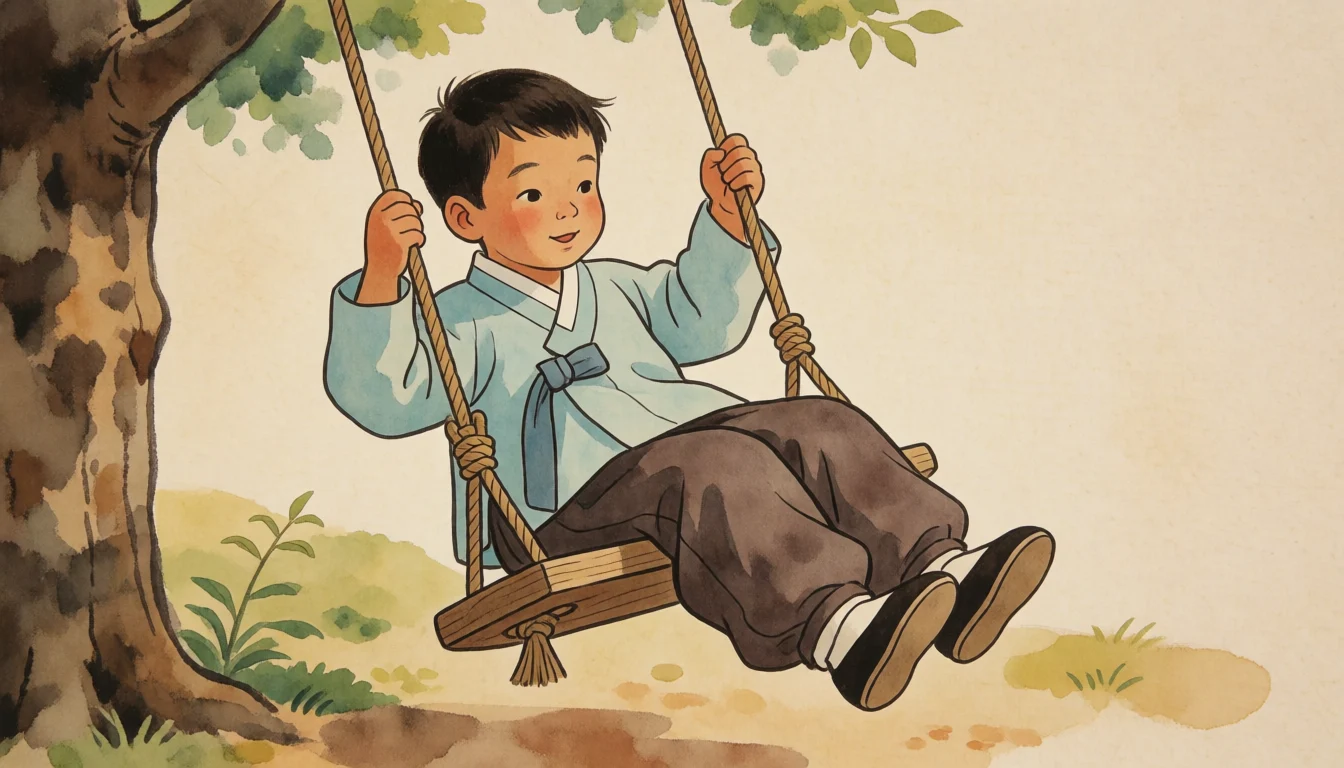
Just as he wiped his sweat, grabbed the ropes, and cautiously stepped up, the plank tilted and flipped completely upside down. Dungi barely managed to grab the ropes, almost landing squarely on his backside. The heights of the knots on both sides were mismatched, and the footboard’s grooves had been threaded backward, causing the ropes to spin loosely.
“Oh dear, why did it end up hanging like this…”
Dungi scratched his messy hair, sweating profusely, right at that moment.
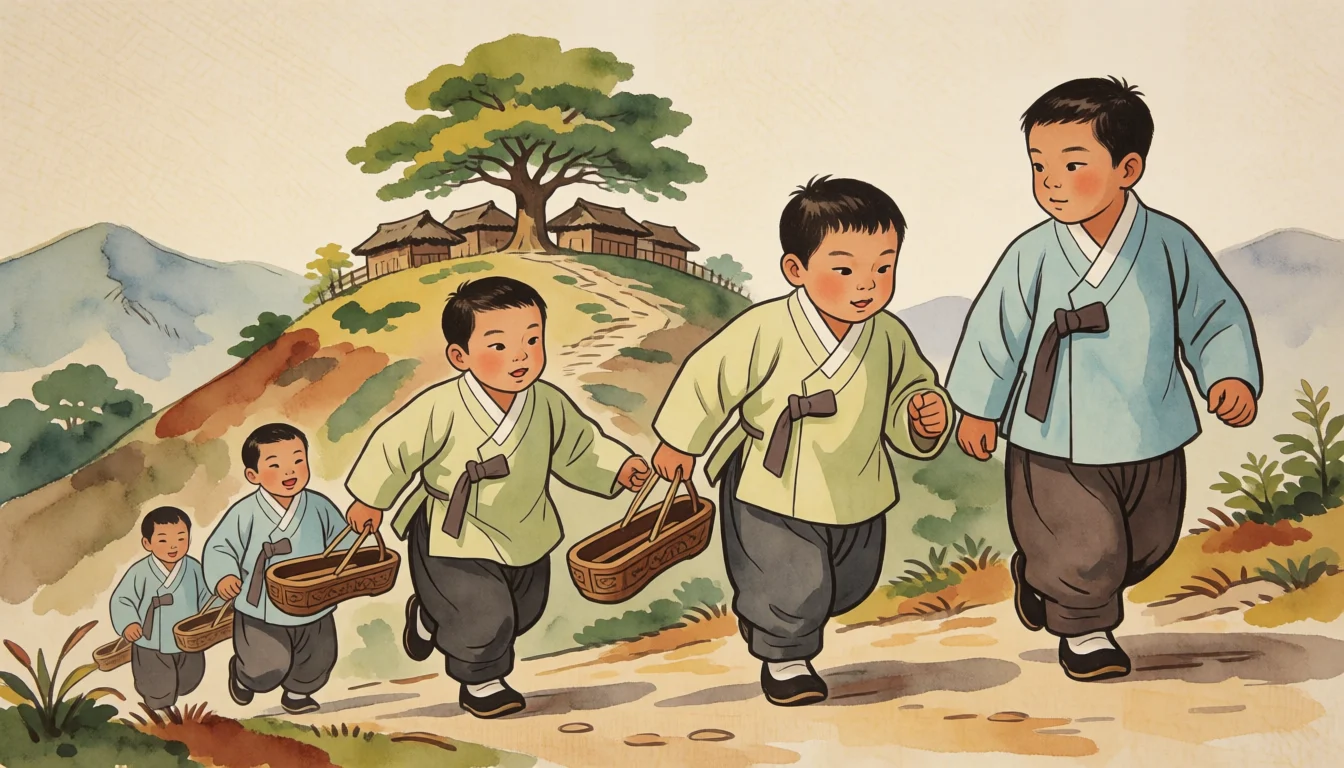
Pati’s Breathless Arrival and Hidden Reason
“Dungi! Dungi, I’m sorry!”
From far up the hill, Pati came running breathlessly, gasping for air. In both hands, Pati carried a well-carved, sturdy wooden footboard and two strips of cotton cloth. His face was covered in sweat and sawdust.
“Where have you been goofing off all this time? I nearly broke my back trying to rig this rope all by myself!”
As Dungi snapped at him, Pati collapsed onto the ground, panting and waving his hands.
“Goofing off? Who? I’ve been carving rope grooves on both sides of the footboard since yesterday, but my adze work was clumsy and I split two pieces of wood! I spent all night carving and refining a new one, which is why I’m only bringing it now. Looking at the mess you tied up by yourself… I see you struggled just as much, huh?”
Seeing Dungi’s upside-down, dangling footboard, Pati burst into a chuckle. Dungi closed his mouth sheepishly, looking somewhat embarrassed.
Hanging Heads Together to Tie the Safety Rope and Footboard
“If I’d acted like a know-it-all, I would’ve made a fool of myself at tomorrow’s Dano event. Let’s do it right this time.”
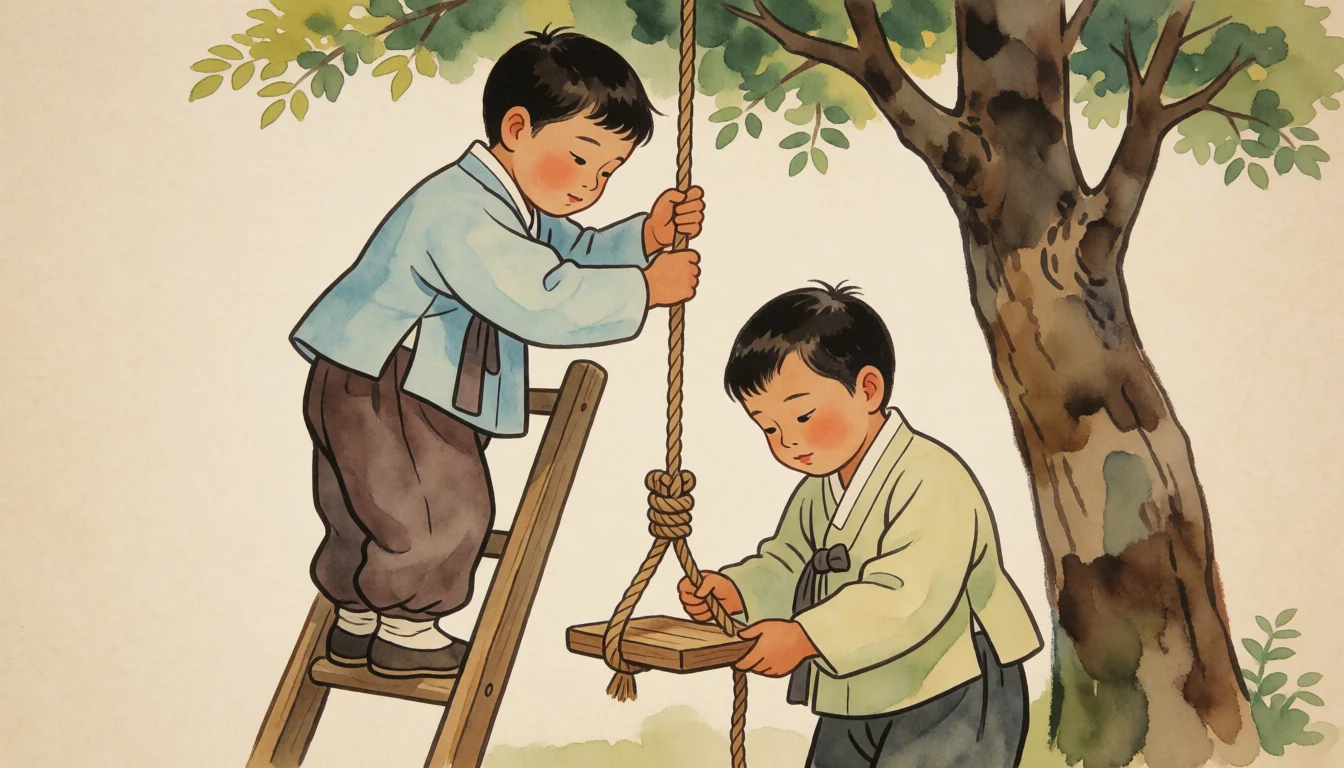
As Dungi held out his hand, Pati grinned and stood up. The two untied the sloppy knots and coordinated step by step. While one person stood on the ladder to adjust and tension the ropes, the other worked below, fitting the hemp ropes securely into the grooves of the footboard and tying firm knots.
“Don’t forget to attach the cotton safety ropes to support our wrists, either. If our hands slip while catching the wind, it’ll be a disaster.”
Pati handed Dungi a strip of cotton cloth from his pocket. Once they tied the safety ropes to firmly support both hands, a sturdy, unwavering swing was finally complete. The ropes that had caused so much trouble when struggled with alone were now hung straight and true, without a single flaw, once the two joined forces.
The First Swing Soaring into the Air and the Flying Straw Sandal
“Now that it’s all tied up, shall we give it a spin?”
Dungi stepped up first, slipping his wrists through the cotton safety ropes and gripping the cords tightly. As Pati pushed the swing with all his might from behind, Dungi bent and straightened his knees, kicking off vigorously.
‘Whoosh—’
Cutting through the fresh green breeze ahead of Dano, his body soared into the air. The zelkova leaves rushed close and then receded repeatedly. Just as Dungi, overcome with a liberating sense of exhilaration, tightened his leg muscles in excitement,
“Heave-ho!”
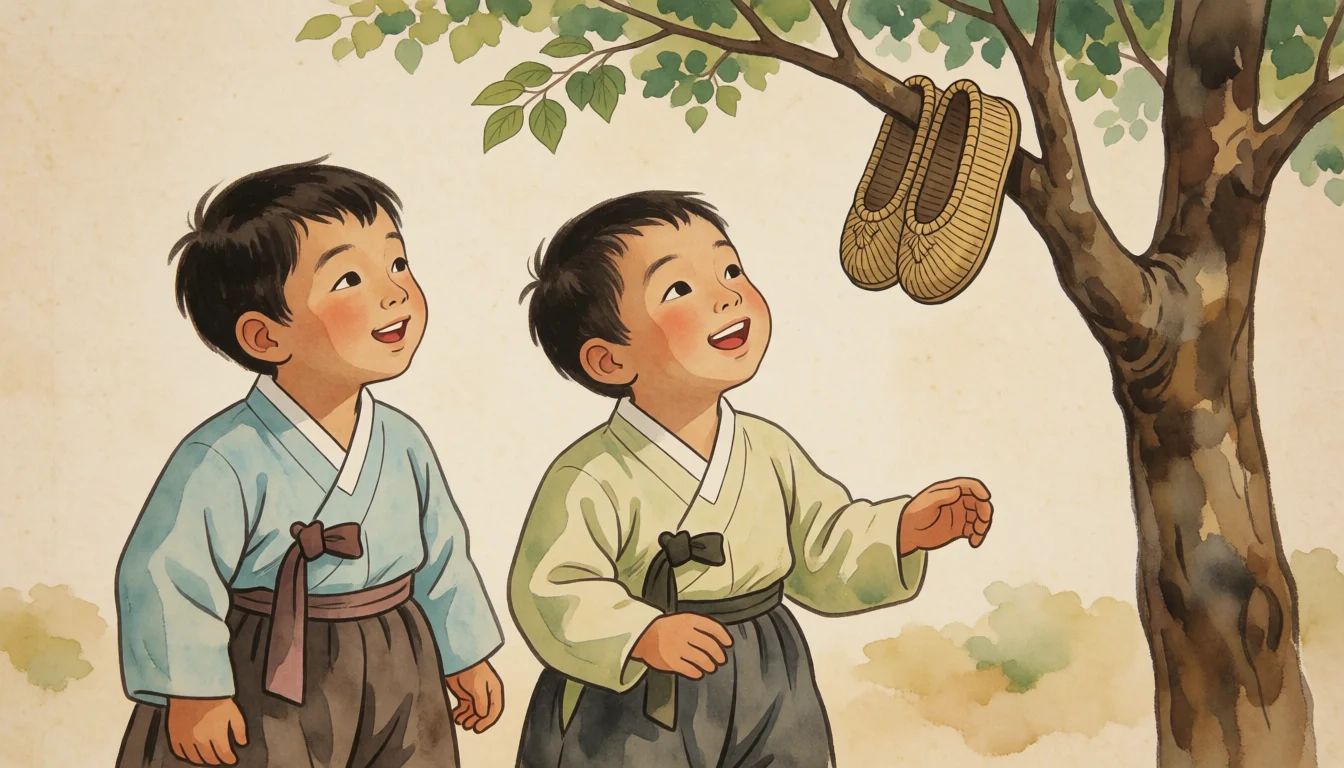
Kicking off too hard, one of his loosely worn straw sandals slipped right off his foot and flew into the air. The sandal drew an arc before landing snugly in the gap of a high side branch of the zelkova tree, dangling and dancing.
Laughter Caught in the Lush Green Branches
As the swing slowed down and Dungi stepped onto the ground with one bare foot, Pati rolled on the ground holding his belly, bursting into laughter.
“Hahaha! Dungi, you were supposed to ride the swing, not show off your shoes! How are we supposed to get that down from up there?”
“Don’t laugh! Tomorrow at the Dano competition, I’ll soar all the way to the top and kick it down myself, you’ll see!”
Dungi couldn’t help but laugh wryly, looking down at his bare foot. They brought a long pole, but the branch where the sandal was caught was simply too high to reach. In the end, the two looked up at the shoe stuck in the tree, locked eyes with each other’s sweat-streaked faces, and laughed out loud. The nervous impatience of the morning, when they had struggled alone in frustration, had completely washed away in the breeze.
An Exhilarating Flight Cutting Through the Wind on Dano Day
At last, on the morning of Dano, villagers dressed in colorful clothes gathered at the zelkova swing site. Maidens who had washed their hair in iris water and young men eager to test their strength cheered each other on while waiting their turn.
When it was Dungi and Pati’s turn, the two young men stepped forward proudly, grasping the sturdy hemp ropes. Every time Pati pushed and Dungi propelled his body upward, cheers erupted. As Dungi soared high across the blue sky, reaching the tip of the tree branch, the branch shook in the wind generated by the swing, and the straw sandal caught during practice dropped right into Pati’s outstretched arms.
“Wahahaha, look at that!”
The delighted laughter of the onlookers echoed across the village. Dungi laughed high in the sky as he cut through the wind, and Pati beamed, holding up the fallen straw sandal high. It was truly a delightful and spirited Dano day.
Evolution of the Swing and Its Names
The swing was referred to as ‘chuchun’ (鞦韆) or ‘chuchunhui’ (鞦韆戲) in Chinese historical sources and during the Goryeo dynasty. By the Joseon dynasty, it came to be called by various native Korean dialects such as ‘geunde’, ‘gunde’, ‘geundui’, ‘geundwi’, ‘geuneui’, ‘geuri’, and ‘guri’. Although exact records of when swinging began or when it became associated with the Dano festival do not exist, it established itself as a representative seasonal custom enjoyed by people of all ages, centered around Dano in the fifth lunar month. While young women primarily enjoyed it, it was often practiced on Buddha’s Birthday or Chuseok as well, with young men also joining in.
Historical Functions and Class-Based Aspects
In ancient times, swinging was used for physical training among ordinary people. However, during the Goryeo dynasty, it evolved into a lavish and grand aristocratic game for the ruling elite, with the royal court and officials funding the events. Records show that during the reign of King Hyeonjong of Goryeo, the envoy Gwak Won played the chuchun game on Dano, and texts like the History of Goryeo (Goryeosa) in the biographies of Choe Chung-heon and Choe Yi record banquets held with swings in the palace and upper-class society. After the Joseon dynasty, its function shifted to a folk-level competitive game. The Joseon yangban class, which valued Confucian ethics, considered it improper for young women to expose their entire bodies in public and thus discouraged and cracked down on it. Nevertheless, it persisted and flourished as a Dano folk play among commoners, serving as an opportunity for men and women to exchange glances.
Structure and Regional Customs
A swing is constructed by tying ropes woven from rice straw or hemp to large pine or zelkova branches, with a footboard (or sitting board) attached at the lower end. There were also ‘ground swings’ where two posts were erected on flat ground with a horizontal wooden bar across the top, decorated with colorful cloths, and cotton safety ropes were sometimes added to support both wrists. In the 15th century, Hanyang residents set up swing sites in the back alleys of Jongno four-way intersection during Dano and divided themselves into northern and southern teams to place wagers. In the mid-Joseon period on Mt. Songaksan in Gaeseong, during Dano gut rituals, it was believed that the Grand Queen would play the swing, so a wooden statue was brought out to mimic swinging. Following this folk belief, rumors spread that swinging would harmonize couples, bring children, and ensure longevity, prompting many men and women to rush to ride it.
Following liberation, swinging was revived nationwide under the auspices of private organizations for the May Dano festival, with large-scale swinging competitions held at Seoul’s Namsan, Jangchungdan Park, and Sajik Park, alongside events at various regional festivals. In modern times, large-scale swinging as a seasonal custom is rarely found, surviving mostly through women’s events, regional festival side events, or as casual play for children.
The Dano festival swinging custom, dialect names like ‘geunde’, the structure of hemp ropes, footboards, and cotton safety ropes, and the suppression by Joseon yangban alongside widespread commoner participation are historical facts based on literature and research. On the other hand, the comedic tumult and episodes experienced by fictional youths Dungi and Pati while rigging the swing are fiction created to help readers understand, and should not be confused with historical facts or the origins of the swing.
🎨 Color This Story